
Parkinson’s Care in Cambridge
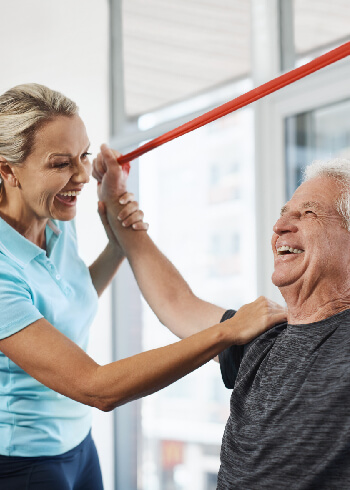 A Parkinson’s diagnosis often comes with the assumption that movement will only get harder from here. But the brain holds onto more adaptability than that diagnosis gives it credit for. Rehab that builds on the brain’s adaptability may help people maintain mobility and function over time.
The Brain’s Ability to Build New Pathways
Parkinson’s affects the neurons that produce dopamine, which disrupts the automatic circuits your brain normally relies on for smooth movement. Neuroplasticity is the brain’s capacity to strengthen surviving pathways and recruit other regions, including the frontal cortex and cerebellum, to help pick up the slack. Movement that used to happen without a second thought may need to become more conscious and deliberate again, and that shift is exactly what rehab is designed to help with.
Why Getting Started Sooner Tends to Pay Off
Early rehabilitation may help people maintain mobility, function, and independence for longer. Common patterns we watch for include smaller, shuffling steps, stiffness that builds through the day, a quieter voice, and moments where the feet feel briefly stuck to the floor. Other symptoms include:
- Reduced arm swing or smaller stride length
- Stiffness or rigidity that worsens with inactivity
- Softer speech or changes in handwriting
- Freezing episodes, especially in doorways or tight spaces
- Balance changes that increase fall risk
When Freezing and Falls Start Raising Concerns
If freezing episodes are becoming more frequent, or a near-fall has you second-guessing your balance in the kitchen or on the stairs, that’s a good time to seek an assessment to discuss rehabilitation options.
Amplitude Training and Freezing Prevention, Built Around You
Our Cambridge program centres on large, high-effort movements that encourage larger, more deliberate movements that help reinforce movement patterns, alongside freezing prevention work that challenges the balance system directly. Visual and auditory cueing gives you practical tools to break a freeze mid-step rather than waiting it out. We also layer in cognitive-motor tasks, like walking while carrying on a conversation, since real life rarely asks you to do just one thing at a time.
What Progress Tends to Look Like
Goals of rehabilitation often include improving walking confidence, reducing freezing episodes, enhancing balance, and supporting everyday mobility. Rehab works alongside medication rather than replacing it, with each playing a different part in your mobility.
Ready to Retrain the Way You Move
Parkinson’s doesn’t have to mean managing decline on autopilot. Helios Physiotherapy and Rehab builds rehab around supporting movement, balance, and function through individualized neurological rehabilitation. Call (548) 489 1009 to book a free consultation.
