
Bulging Disc Treatment in Cambridge
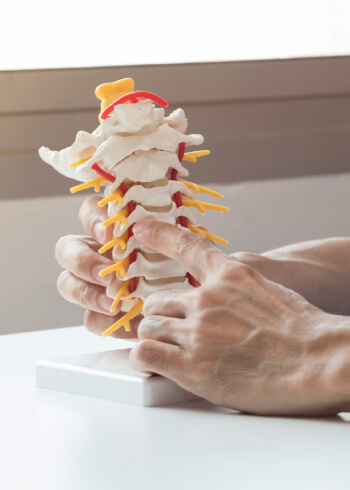 If you are dealing with a bulging disc, ordinary movement can feel unpredictable. Sitting through a meeting, bending forward, or turning your head can suddenly trigger pain, stiffness, or radiating discomfort that changes how confidently you move through the day.
The good news is that many people with bulging discs respond well to conservative rehabilitation focused on restoring movement, reducing irritation, and improving spinal support.
What Is a Bulging Disc?
Your spinal discs act as cushions between the vertebrae, helping absorb load and distribute pressure throughout the spine. Each disc contains a firm outer layer and a softer, gel-like centre.
A bulging disc occurs when the inner material pushes outward against the outer rim, causing the disc to protrude into the spinal canal. Unlike a herniated disc, the outer layer remains intact. This protrusion can reduce normal spinal mobility and, in some cases, place pressure on nearby nerves.
Why Bulging Discs Become Painful
Symptoms vary depending on the location and severity of the bulge. Some people experience localized pain and stiffness in the neck or lower back, while others notice symptoms radiating into the arms, buttocks, or legs.
A bulging disc may contribute to:
- Sharp or aching pain with bending, sitting, or rotation
- Numbness or tingling into the limbs
- “Electric” or radiating nerve sensations
- A feeling that the back or neck becomes mechanically “stuck”
- Muscle guarding and reduced range of motion
If inflammation increases or the disc continues to weaken over time, a bulge can progress into a herniated disc, where the inner material breaks through the outer layer and creates additional irritation around the spinal nerves.
Common Causes of a Bulging Disc
Bulging discs are usually the result of accumulated stress rather than a single isolated event. Repetitive lifting, prolonged slouched posture, age-related spinal degeneration, sudden trauma, reduced core stability, and physical deconditioning can all increase pressure on the discs over time.
Limited movement variety throughout the day may also contribute, especially when the spine is repeatedly loaded in the same positions. Over time, the body may begin creating compensation patterns to avoid pain, which can place additional strain on the hips, neck, or surrounding muscles.
A Movement-Based Approach to Recovery
At Helios Physiotherapy and Rehab, rehabilitation focuses on improving movement tolerance and helping the spine function more efficiently under load.
Care begins with a detailed assessment to identify the affected spinal region, nerve involvement, mobility restrictions, and compensation patterns. Treatment may include spinal mobilization, manual therapy, myofascial release, and movement-based rehabilitation to improve range of motion and reduce irritation around the affected tissues.
The McKenzie Approach may also be incorporated to progressively reintroduce extension and controlled spinal loading. Additional therapies such as spinal traction or decompression therapy, acupuncture, intramuscular stimulation (IMS), Shockwave Therapy, or laser therapy may be used to encourage muscle relaxation and tissue recovery where appropriate.
A major part of rehabilitation involves rebuilding the deep stabilizer muscles that help support the spine naturally. Gradual loading strategies help patients remain active while reducing the risk of repeated flare-ups.
Rather than strict bed rest, the goal is usually relative rest — modifying activities while continuing to move safely and progressively.
When to Seek Immediate Medical Attention
Most bulging discs can be managed conservatively, but urgent medical assessment is recommended if you experience:
- Sudden or severe leg weakness
- Numbness in the groin or inner thigh region
- Loss of bowel or bladder control
These symptoms require immediate medical evaluation.
Frequently Asked Questions
Does a bulging disc always require surgery?
Can I stay active with a bulging disc?
What is the difference between a bulging disc and a herniated disc?
Book an Assessment
If back or neck pain has been changing how you move, work, or sleep, early assessment may help prevent the problem from progressing further. The team at Helios Physiotherapy and Rehab can help you better understand what may be contributing to your symptoms and what recovery may involve. Contact us today to schedule your assessment.
